Howard Gardner’s Multiple Intelligences Theory explains intelligence as eight distinct types that influence how individuals think, learn, and excel. It broadens intelligence beyond logical and linguistic skills to include creative, physical, musical, and interpersonal abilities.
"Intelligence is the ability to solve problems, or to create products, that are valued within on one or more cultural settings"

Ability to use language effectively through speaking, writing, interpretation, and understanding communication and meaning.
Words, reading, writing, speaking
Writers, lawyers, journalists, teachers, speakers, editors, linguists, translators, media professionals.
Writing instructions, speeches, editing content, commenting on events, storytelling.
Logical thinking, pattern detection, problem-solving, mathematical reasoning, and understanding cause-and-effect.
Logic, numbers, analysis
Scientists, engineers, computer experts, accountants, analysts, researchers, bankers, strategists.
Mental calculations, system analysis, strategy creation, evaluating business or processes.
Ability to recognize, create, and understand sound, rhythm, tone patterns, and emotional expression through music.
Music, sound, rhythm
Musicians, singers, composers, DJs, music producers, acoustic engineers, entertainers.
Performing music, singing, reviewing compositions, coaching instruments, sound design.
Ability to use body movement, manual dexterity, physical agility, balance, and coordination to express ideas and solve problems.
Physical experience and movement, touch, and feel
Dancers, sports persons, actors, athletes, fitness trainers, physiotherapists, surgeons, mechanics, ergonomists.
Performing stunts, hands-on experiments, sports practice, building models, posture and movement training.
Ability to perceive, interpret, and create visual images, understand spatial relationships, and think in pictures.
Pictures, diagrams, charts, maps, and visual patterns
Artists, designers, architects, photographers, animators, interior designers, illustrators.
Drawing, designing layouts, visual storytelling, map reading, model creation, creative visualization.
Ability to understand other people’s emotions, intentions, motivations, and behaviors and to interact effectively.
Group discussions, collaboration, teamwork, role-playing
Teachers, counselors, psychologists, managers, HR professionals, sales professionals, leaders.
Team leadership, mentoring, conflict resolution, coaching, group problem-solving.
Self-awareness, personal insight, emotional understanding, and the ability to reflect deeply on one’s thoughts, feelings, strengths, and limitations.
Self-reflection, introspection, self-discovery
Psychologists, philosophers, counselors, writers, spiritual leaders, researchers, entrepreneurs.
Journaling, meditation, goal setting, self-analysis, personal development planning.
Ability to recognize, observe, categorize, and understand plants, animals, ecosystems, and natural patterns.
Hands-on exploration, observation of nature, real-world experience
Environmental scientists, zoologists, botanists, veterinarians, farmers, conservationists, researchers.
Nature observation, gardening, wildlife study, environmental research, outdoor exploration.
Walter McKenzie’s Multiple Intelligence framework (1999–2013) builds on Dr. Howard Gardner’s theory by organizing the eight intelligences into three structured learning domains. These domains act as a practical guide for understanding how different intelligences work together, interact fluidly, and influence the way individuals learn, think, and apply skills in academic and real-world environments.
Visual + Intrapersonal – 38%
Logical + Musical + Naturalist – 38%
Verbal + Interpersonal + Kinesthetic – 24%
The Analytical domain consists of logical, musical, and naturalist intelligence. These intelligences support analytical thinking, pattern recognition, and the ability to organize and interpret data to build knowledge.
The Interactive domain includes verbal, interpersonal, and kinesthetic intelligence. These intelligences are used to communicate ideas, collaborate with others, and actively explore the surrounding environment.
The Introspective domain is based on intrapersonal and visual intelligence. It emphasizes self-awareness, reflection, and learning through personal experiences, beliefs, and inner understanding.
Holland Codes represent a set of personality types described in a theory of careers and vocational choice formulated by psychologist John L. Holland. Holland's Theory argued that 'the choice of a vocation is an expression of personality' and that the six factor typology he articulated could be used to describe both persons and work environments.
His typology provides an interpretative structure for a number of different vocational interest surveys, including the two measures he developed: The Vocational Preference Inventory and the Self Directed Search. His model has been adopted by the U.S. Department of Labor for categorizing jobs relative to interests.

Hands-on, tool-oriented & outdoor activities
Research, curiosity & scientific thinking
Creativity, expression & design
Leadership, action & decision making
Planning, structure & data handling
The O*NET Career Framework is a standardized occupational classification system developed to describe careers based on skills, abilities, knowledge, work activities, and work environments. It provides structured career data that helps individuals understand what different jobs truly require beyond just job titles.
Used globally by educators, counselors, and workforce platforms, the O*NET model enables accurate career matching by connecting personal strengths with real-world job demands. It plays a vital role in career planning, skill development, and informed decision-making in today’s evolving job market.
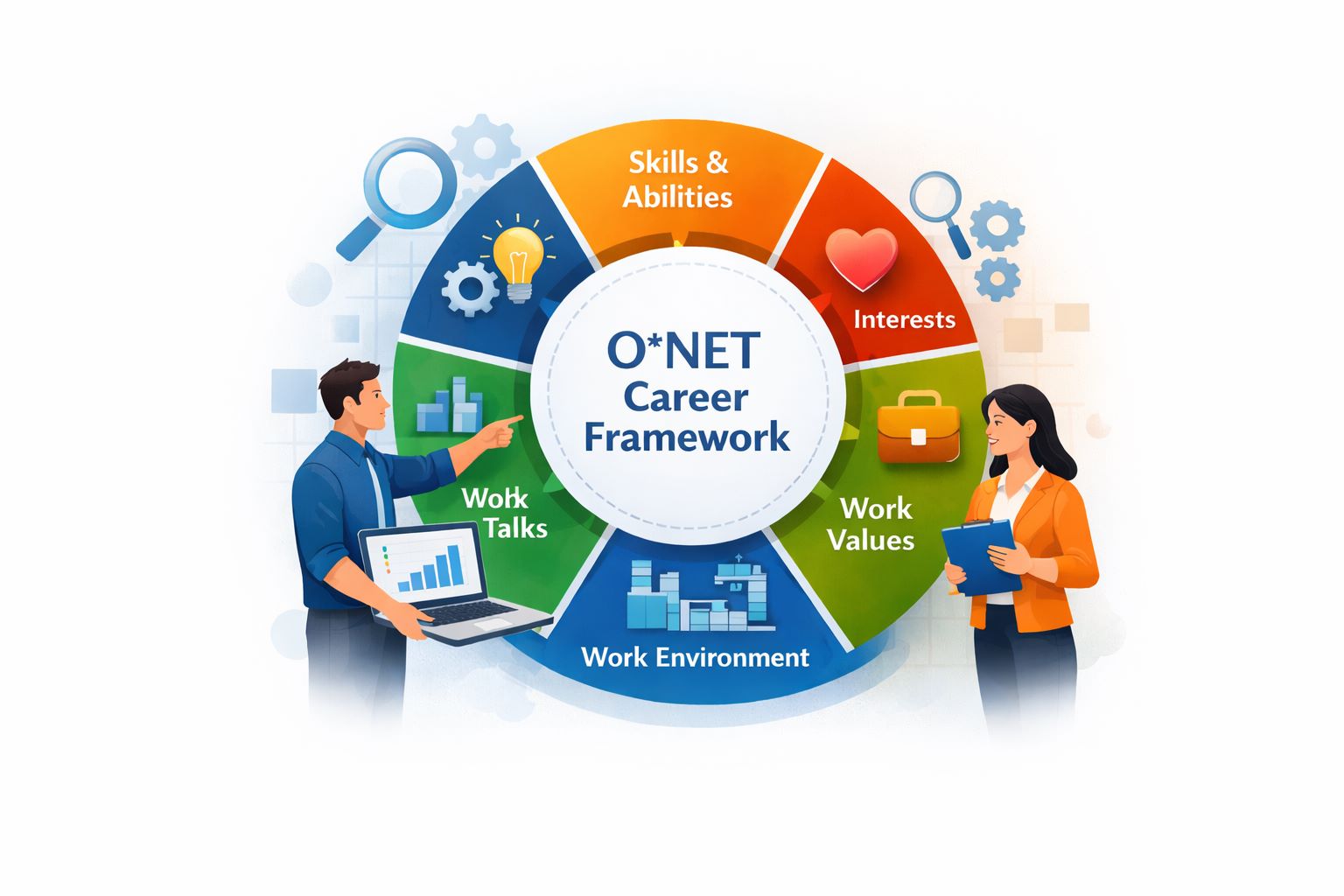
Defines the practical skills and cognitive abilities required to perform occupations effectively.
Connects career paths with personal interests to enhance engagement and long-term satisfaction.
Highlights core workplace values such as independence, recognition, and professional growth.
Describes the physical, social, and organizational conditions associated with each occupation.